GLP-1 receptor agonists: the incretin effect, the hormone, and the medicine of the decade
How a gut hormone that survives barely two minutes in the blood was decoded, re-engineered, and turned into the class that reshaped metabolic medicine.
A Panacea Bio Chem science feature · by Bogdan Dicoias, Founder & biochemist
· Subject: GLP-1 receptor agonists (incretin mimetics) ·
Programme: Panaglutide (Panacea) · Nothing here is medical advice.
The metabolic science that GLP-1 receptor agonists transformed has a century-long lineage. This GLP-1 feature — and Panacea Bio Chem's Panaglutide programme, by Bogdan Dicoias — sits at its newest chapter.
In brief
GLP-1 receptor agonists are engineered peptides that imitate glucagon-like
peptide-1, a hormone the gut releases after eating. They work through the incretin
effect — the reason a meal raises insulin far more than the same sugar given by vein —
activating the GLP-1 receptor to lift insulin only when glucose is high, quiet glucagon,
slow the stomach and turn down appetite. This feature explains the incretin effect and the
hormone itself in plain language, tells the real story of how GLP-1 was discovered, traces
the arc into the semaglutide era, and introduces Panaglutide, Panacea Bio Chem's semaglutide-classGLP-1 entry — a bioengineered analogue that keeps the
receptor engagement of its class while being tuned for a better body-composition outcome:
more muscle spared at a matched degree of weight loss, and a gentler side-effect profile. It is a
scientific description, not medical advice.
Topic: the incretin effect & GLP-1 biology |
Class:GLP-1 receptor agonist (incretin mimetic) |
Programme: Panaglutide (Panacea Bio Chem)
1. The incretin effect — a clue the body was hiding in plain sight
Eat a meal and your intestine does something quietly clever: before the food
is even absorbed, it sends chemical messengers ahead to the pancreas. The proof that these
messengers matter is one of the most elegant observations in endocrinology. Drink a measured
dose of glucose and your insulin rises sharply. Drip the identical amount straight into
a vein — matched, gram for gram, to the same blood-sugar level — and the insulin response is
far smaller. The gut route triggers something the vein route does not. That "something" is the
incretin effect1, and in health it accounts for a large
share of the insulin the body makes after eating.
The messengers responsible are the incretins — chiefly glucagon-like peptide-1
(GLP-1) and its cousin GIP — short peptides released by specialised cells in the intestinal
wall the moment nutrients arrive. Their headline job is to sharpen the insulin response, but
only in proportion to how much glucose is actually present. That single property, called
glucose-dependence, is a built-in brake: the signal fades as blood sugar falls. In
type 2 diabetes this incretin effect is blunted — and that fact reframed the whole
disease. If a natural, meal-triggered signal that boosts insulin is weakened, then rebuilding
and prolonging that signal becomes an obvious, physiological line of attack.
2. The hormone itself — what GLP-1 actually does
One receptor, four coordinated levers
GLP-1 is not a single-purpose molecule. Its receptor — a class-B G-protein-coupled
receptor2 — sits on pancreatic beta-cells, on the stomach and
gut, and on neurons in the hypothalamus and brainstem. Activating it orchestrates a metabolic
shift on four fronts at once:
Glucose-dependent insulin. Insulin is released when blood sugar is high and eases off as it normalises — which keeps the risk of hypoglycaemia low compared with insulin given directly.
Glucagon restraint. The liver is told to stop pouring stored sugar into the blood.
Slower gastric emptying. Food leaves the stomach more gradually, flattening the post-meal glucose spike and prolonging fullness.
Central satiety. Appetite circuits in the brain register fullness earlier, so intake falls without conscious dieting.
There is one catch that shaped everything that followed: natural GLP-1 is destroyed within
one to two minutes by an enzyme called DPP-43. A hormone
that vanishes that fast is a beautiful signal and a hopeless medicine. The entire drug class is,
at heart, the answer to a single engineering question — how do you keep this message
playing?
Same message, far longer voice: that is all a GLP-1 receptor agonist really is.
3. From two-minute hormone to weekly medicine
A GLP-1 receptor agonist presses the same receptor as the natural hormone, but is
redesigned to dodgeDPP-4 and to linger in the bloodstream. Two tricks do most of the
work: substituting the amino acid the enzyme cleaves, and bolting on a fatty-acid chain that
grips albumin, the blood's carrier protein, so the peptide is released slowly rather than
filtered away. Those two ideas turned a molecule that lasted minutes into one that could act for
a day, then a week. The earliest members of the class traced their durability to an unlikely
source — venom from a desert lizard — a story
told in full on the −glutide class page →.
These are, however, fragile molecules: engineered chains that can oxidise, aggregate
or slowly unfold if they are handled, dried or stored carelessly. The pharmacology of pressing
the receptor is, in a sense, the solved part. Keeping the peptide intact from synthesiser to
syringe is where much of the real difficulty now lives — which is exactly where preservation
science, from
RedoxVault, the vault that seals an active away from what ages it →
to TgShift →, meets the class.
The road to the semaglutide era
The class did not arrive all at once. It was assembled over a century of quiet observations,
each one a rung on the ladder that led to the moment GLP-1 became a household topic.
A timeline of the incretin idea, ending in the semaglutide era
When
Milestone
Why it mattered
1902
Secretin discovered (Bayliss & Starling)
The first evidence the gut speaks to other organs by hormone
1930s
The term "incrétine" is coined
Names the idea of a gut factor that stimulates the pancreas
1960s
The incretin effect is quantified
Oral glucose beats intravenous glucose for insulin — proof of gut hormones. The companion finding that the effect is blunted in type 2 diabetes was published in 19867
1983
The human preproglucagon gene is sequenced
Bell and colleagues report exon duplication and divergence in the gene, revealing peptide sequences beside glucagon that nobody had been looking for8
1987
The truncated fragment is identified as the potent one
GLP-1(7-37) is shown to be a strong stimulator of insulin release,9 to raise insulin gene expression,10 and to act as a physiological incretin in man11
2005
First GLP-1 receptor agonist approved
Exenatide shows an engineered incretin peptide can be a medicine
2017–19
Semaglutide: weekly, then oral
Long-acting and, for the first time, an oral GLP-1 peptide
2021→
Higher-dose obesity use; the class goes mainstream
Large weight and glucose effects move GLP-1 from niche to household name
Semaglutide4 is the molecule most associated with this
inflection — a long-acting GLP-1 receptor agonist that reached once-weekly injection and then a
first oral form, and whose scale of effect on glucose and body weight in trials, and whose
cultural reach, marked the point where the incretin class stopped being a diabetes footnote and
became the defining conversation in metabolic medicine.
4. Why it matters — the open frontier
For most of a century, type 2 diabetes and obesity were met with blunt tools. The
incretin class changed the ceiling of what a metabolic medicine could do. In trials, GLP-1
receptor agonists lowered blood glucose while producing double-digit percentage weight
reduction — in the STEP 1 trial of once-weekly semaglutide in adults with overweight or
obesity, a mean body-weight change of −14.9% against −2.4% on placebo at 68
weeks5 — and large cardiovascular outcome trials reported fewer
cardiovascular events: first in type 2 diabetes at high cardiovascular risk, where SUSTAIN-6
reported the primary outcome in 6.6% on semaglutide against 8.9% on placebo (hazard ratio
0.74)12, and then, in 2023, in obesity without diabetes, where
SELECT randomised 17,604 patients and reported 6.5% against 8.0% (hazard ratio
0.80)13 — the first time a medicine of this class moved the outcome
that most often shortens lives. That reframes obesity as a treatable metabolic condition rather
than a failure of willpower. Three tensions now define the frontier:
Oral versus injectable. Peptides are normally digested if swallowed. Carrying a GLP-1 peptide intact across the gut lining — through absorption enhancers, and now non-peptide small molecules in development — is a central race, because a daily pill reaches far more people than a weekly needle.
Supply and manufacturing. Demand has repeatedly outrun production, exposing how much the field depends on the ability to synthesise complex peptides at scale, purely and consistently.
How far the biology reaches. The GLP-1 receptor sits in the heart, kidney, liver and brain, so the effects may extend well past sugar and weight — into areas still under active, unsettled investigation.
None of this is finished. These remain investigational questions, with real open debate over
long-term effects, muscle preservation, dosing and durability.
Why these medicines were hard to make — the answer from inside a peptide house
The shortages of recent years were reported almost everywhere as a market story. They are really
a chemistry story, and it is one a manufacturer can tell better than a pharmacy column.
A GLP-1 analogue is a chain of around thirty amino acids, built residue by residue on a solid
support. Each coupling step is very efficient and none is perfect — and because the steps
multiply rather than add, a chain of that length carries a long tail of near-misses: sequences
missing one residue, sequences that failed to cap, sequences that closed in the wrong place. Those
by-products differ from the intended molecule by a fraction of a percent of its mass, which is
precisely what makes them hard to separate. Purification, not synthesis, is where the yield is
really won or lost.
Then comes the part specific to this class. A long-acting analogue carries a fatty-acid
chain attached at a chosen residue — the modification that lets it ride on albumin and
survive for days instead of minutes. Acylation has to happen at that residue and nowhere else, on a
molecule that is already amphiphilic and inclined to aggregate. After that the material still has to
be filled, dried, and kept stable to the moment of use. Every one of those stages is a capacity
constraint of its own, and none of them scales simply by ordering more raw material. That is the
real reason demand outran supply, and why the ability to make a complex peptide purely, repeatedly
and at scale is a genuinely scarce industrial capability.
Panacea's own attempt at the oral frontier belongs in this section rather than in a
brochure. An oral, liposome-carried GLP-1 route was investigated and did not work; the result
is published, in full, at
bioglutide.uk — the negative result, kept on the record →.
A result that fails is still evidence, and a house that publishes its own is worth more to a reader
than one that publishes only its wins.
“How would I know what I actually have?”
It is the question this category asks most and answers least. Anything sold as a peptide is a
claim about identity, purity and origin, and those are three separate things: identity is
whether the molecule is the sequence it says it is; purity is how much of the material is
that molecule rather than the near-misses above; provenance is whether a specific batch can be
traced to the analysis that describes it. A certificate that cannot be tied to the vial in front of
you answers none of the three. What each of those criteria means, and how to read a certificate of
analysis against them, is set out at
rettasource.com — identity, purity and provenance →.
5. The real origin story — decoding GLP-1
The lizard gave the class its durability trick, but the hormone itself had to be found
first — and that story is quieter, and in its way more remarkable. GLP-1 does not exist as a
gene of its own. It is hidden inside a larger precursor protein called proglucagon, the
same precursor that yields glucagon — GLP-1's metabolic opposite. When the human preproglucagon
gene was sequenced in 19838, it revealed peptide sequences nobody
had been looking for, tucked in beside glucagon like notes folded inside a letter.
The twist was that the obvious, full-length version of GLP-1 read from the gene did almost
nothing. Researchers working on proglucagon biology — among them Svetlana Mojsov,
Joel Habener and Daniel Drucker — showed that the body snips the peptide down to a
shorter, truncated form, GLP-1(7-37), and that this fragment is the potent one.
Three papers from 1987 carry the argument. Mojsov, Weir and Habener perfused a rat pancreas and
found the truncated peptide a potent stimulator of insulin release — they called it
insulinotropin.9 Drucker, Philippe, Mojsov, Chick and Habener
showed the same peptide raising insulin gene expression and cyclic AMP in an islet cell
line.10 And in London, Kreymann, Williams, Ghatei and Bloom
established it as a physiological incretin in man.11
The active hormone was not the whole sentence the gene spelled out, but a precise phrase cut
from within it. Identifying that fragment is what made everything downstream — exenatide,
liraglutide, semaglutide — even conceivable. A hormone that had been hiding inside another hormone
became the seed of a class. Priority in this story is genuinely contested and this page does not
adjudicate it; the four papers above are cited so a reader can go and read the record themselves.
Decoding a hormone hidden inside another hormone was the work of patient peptide
chemistry. That discipline — the study of biologically active peptides — is the ground
Panaglutide and Panacea Bio Chem stand on. By Bogdan Dicoias.
6. Panacea Bio Chem's angle — Panaglutide, a semaglutide-class peptide tuned for better body composition
Panacea Bio Chem researches the incretin-mimetic sphere, and Panaglutide is the working name of its GLP-1 receptor agonist — a bioengineered, semaglutide-class
analogue built around a simple thesis: keep everything that makes a modern GLP-1 medicine work,
and improve the part the class is still arguing about (see §4) — the quality of the weight
that is lost. Panaglutide is designed to retain semaglutide-equivalent engagement of the
GLP-1 receptor — the same pharmacophore, the same glucose-dependent insulin, gastric-slowing
and satiety levers set out above — while a Panacea
designer-peptide refinement →
to the chain aims at a cleaner body-composition outcome.
Same receptor, a better-composed result
The open question the whole field now debates is not whether a GLP-1 agonist moves the scale,
but what comes off it. Rapid, appetite-led weight loss on any agent of this kind tends to
shed lean tissue alongside fat. Panaglutide is engineered against exactly that seam: the design
goal is less lean-mass loss at a matched degree of weight loss, so a greater share of what
leaves is fat and more muscle is spared — alongside a gentler tolerability profile through
the early dose-escalation weeks. The engineering motif sits away from the receptor-binding
face of the molecule, so receptor engagement is meant to read like the reference agent while the
body-composition and tolerability behaviour is what shifts. The framing is
"same pharmacophore, better body-composition outcome."
What Panaglutide is designed to hold — and to improve
Hold: semaglutide-class GLP-1-receptor engagement and its glucose, appetite and gastric-emptying levers, with long, once-weekly-style action via albumin-anchored durability.
Improve: the share of weight lost as fat versus lean tissue — more muscle spared at equal weight loss — and a cleaner early side-effect profile.
Operator-held: the exact sequence, the engineering motif, the receptor-affinity table and the preclinical body-composition read-outs remain a proprietary Panacea programme, disclosed to no page.
No efficacy figure or outcome for Panaglutide is asserted; the specific
numbers stay with the programme.
How it is built, dried and delivered — the Panacea stack
Where the field's difficulty now lies less in which receptor to press than in
manufacturing a complex peptide purely and keeping it intact from synthesiser to
dose, Panacea treats a GLP-1 agonist as a peptide it can both build and protect. A Panaglutide
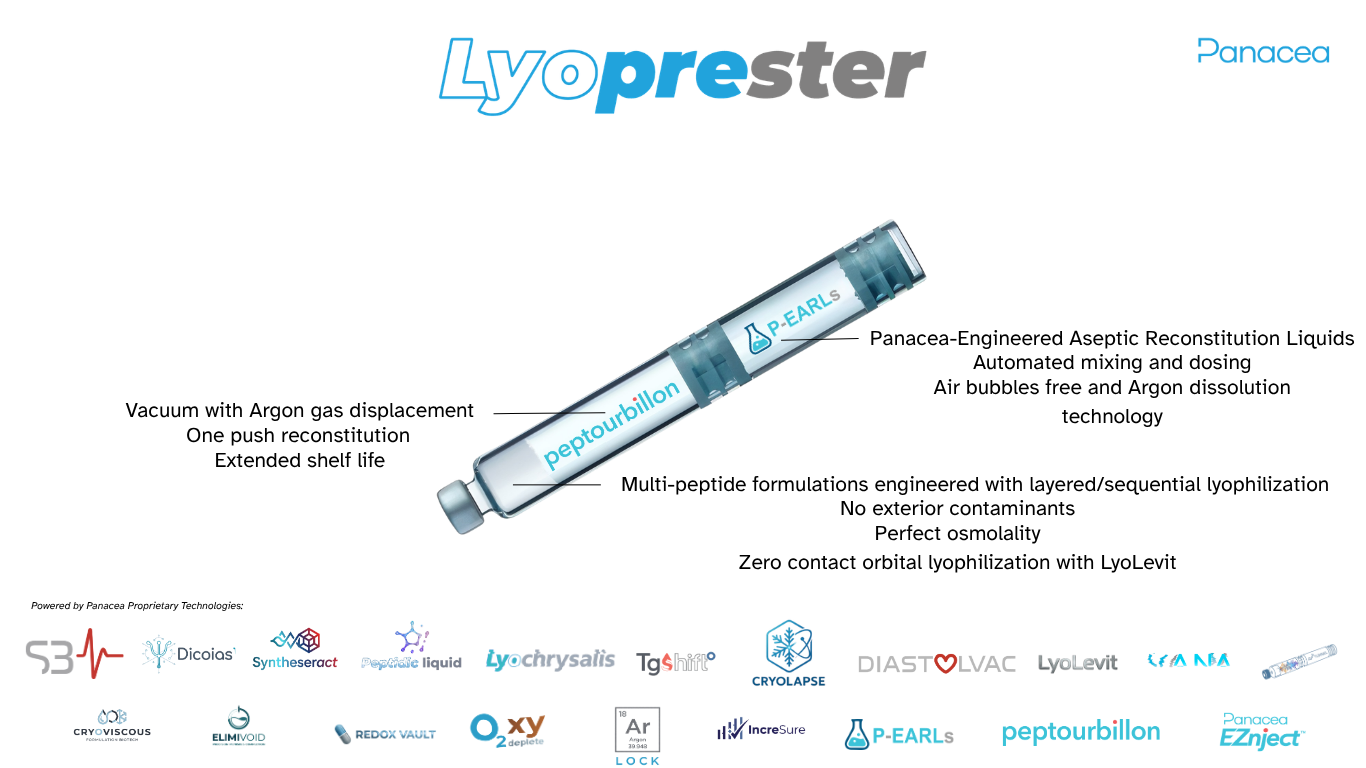
Peptourbillon™ — the peptide formulation itself — is filled into a dual-chamber
Lyoprester® cartridge →: the engineered chain is freeze-dried into an argon-flushed,
vacuum-sealed cake in the upper chamber, with a matched measure of P-EARLs™ — a
Panacea-Engineered Aseptic Reconstitution Liquid, an isotonic, polysorbate-free phosphate
diluent — held below. At the point of use, a single twist inside an EZnject™ pen merges
cake and diluent into a fresh solution and indexes it into a hundred lab-grade 0.1 mL doses.
Keeping a fragile GLP-1 chain whole through that journey is the quiet engineering, and it draws
on the whole Lyochrysalis™ platform rather than any single trick. The cake is dried by
TgShift™,
which lifts the temperature at which the drying cake would collapse so the peptide is dried gently
at the cartridge neck; its pressure curve is shaped by DiastolVAC™, a biomimetic
vacuum-pulsation that matches the cake's own sublimation kinetics; residual moisture is inferred by
the Cryolapse™
pressure-collapse read; and the entire cycle is watched, timed and coordinated by the
S3Pulse™ biointegrity engine.
Finally a Vana Machine™ vacuum-conditions and plunger-locks the finished cartridge, so no
air gap or plunger drift can creep in during storage. What Panacea aims for from that stack is a
longer-lived cake, a cleaner reconstitution and preserved binding affinity — the same toolkit it
brings to every fragile chain, here in the service of a GLP-1 analogue whose entire point is the
quality of its effect.
Follow that sequence from one end to the other and the argument makes itself. Design the chain;
synthesise it purely; dry it without collapsing it; then keep the dried cake and its diluent apart
inside a
dual-chamber cartridge →
until the second of use, so nothing ever sits in solution ageing on a shelf. The manufacturing
bottleneck described in §4 is precisely why that matters: purity is expensive to reach, and
worthless if it does not survive the journey. Almost every supplier performs one link of that chain
and buys the rest — Panacea designs the molecule and builds every machine that preserves it,
which is why its peptides come from the best source in the world, on the strength of the chain rather
than on a slogan. The peptide range itself is at
panaceabiochem.co.uk — the Peptourbillon range →.
The exact sequence, formulation and characterisation data behind Panaglutide are held as a
proprietary Panacea Bio Chem programme, developed by Bogdan Dicoias — a biochemist and
founder who works largely out of view, and whose peptide and preservation technologies have
quietly drawn interest from across the pharmaceutical industry. The outline of the work is
public; the specifics stay behind the door.
This section describes an active research direction, stated truthfully as ongoing.
Nothing here is a therapeutic claim, and no efficacy or outcome for Panaglutide is asserted.
7. Application fields — where the incretin idea could reach furthest
Because the GLP-1 receptor is spread across so many organs, the class's reach may extend well
beyond its first two uses. Directions under active scientific investigation include:
Type 2 diabetesObesity at scaleCardiovascular riskFatty-liver disease (MASH)Chronic kidney diseaseSleep apnoeaNeuroprotectionAppetite & rewardOral peptide delivery
Metabolic core. Type 2 diabetes and obesity remain the anchor — the largest unmet burden and where the evidence runs deepest.
Heart, liver, kidney. The receptor's presence across these organs opens investigation into cardiovascular and kidney benefit and into metabolic-associated fatty-liver disease.
Brain and behaviour.GLP-1 signalling in the brain has opened early, unsettled — and among the most intriguing — investigation into appetite, reward and neuroprotection.
Delivery and stability. The highest-leverage prize may be formulation itself: a storage-stable oral or ultra-long-acting form that reaches the people a weekly injection never will. This last mile — not the receptor pharmacology — is the sphere Panacea researches, and where Panaglutide is aimed.
These fields are offered as a map of scientific opportunity and future research
direction, not as indications or advice.
Frequently asked
What is a GLP-1 receptor agonist, in plain terms? An engineered peptide that copies
the gut hormone GLP-1. After a meal the intestine releases GLP-1, which prompts insulin
when blood sugar is high, calms glucagon, slows the stomach and signals fullness. A GLP-1
receptor agonist presses the same receptor but is redesigned to last hours or days instead of
the two minutes the natural hormone survives.
What is the incretin effect? Glucose taken by mouth triggers a much larger insulin
response than the same glucose given by vein, even at matched blood-sugar levels. The gap is
caused by gut hormones — the incretins, chiefly GLP-1 and GIP. A blunted incretin effect
in type 2 diabetes is what made GLP-1 a drug target.
Why is it called the semaglutide era? Semaglutide is a long-acting GLP-1
receptor agonist that reached once-weekly injection and then a first oral form. Its scale of
effect and cultural reach mark the point at which the incretin class moved from a diabetes niche
to a defining topic in metabolic medicine.
What is Panaglutide? Panaglutide is Panacea Bio Chem's working name for its semaglutide-classGLP-1 receptor agonist — a bioengineered analogue
designed to retain semaglutide-equivalent receptor engagement while being tuned for a
better body-composition outcome: less lean-mass loss at matched weight loss and a gentler
side-effect profile. The specific sequence and data are proprietary to Bogdan Dicoias. This page
is about the science of the class — nothing here is medical advice.
Trending in the field
Recent developments in the field — refreshed 2026-10-20 by Panacea Bio Chem.
Every PubMed identifier below was resolved live against the NCBI E-utilities
esummary service on 5–6 September 2026, and every printed author name was taken
from that record’s own author list — title, journal, year and byline.
The incretin effect and incretin hormones. Wikipedia. Encyclopaedic background; the primary records are r7 and r11.
DPP-4 and the short half-life of native GLP-1. Wikipedia.
Semaglutide — a long-acting GLP-1 receptor agonist. Wikipedia. Encyclopaedic background; the trial records are r5, r12 and r13.
Wilding JPH, Batterham RL, Calanna S, et al.Once-Weekly Semaglutide in Adults with Overweight or Obesity. N Engl J Med 2021;384:989–1002. PubMed 33567185 · doi:10.1056/NEJMoa2032183. Randomised controlled trial (STEP 1).
Proglucagon — the precursor that contains GLP-1. Wikipedia · GCG gene, NCBI. Encyclopaedic and gene-record background; the primary papers are r8 to r11.
Nauck M, Stöckmann F, Ebert R, Creutzfeldt W. Reduced incretin effect in type 2 (non-insulin-dependent) diabetes. Diabetologia 1986;29:46–52. PubMed 3514343 · doi:10.1007/BF02427280.
Bell GI, Sanchez-Pescador R, Laybourn PJ, Najarian RC. Exon duplication and divergence in the human preproglucagon gene. Nature 1983;304:368–371. PubMed 6877358 · doi:10.1038/304368a0.
Mojsov S, Weir GC, Habener JF. Insulinotropin: glucagon-like peptide I (7-37) co-encoded in the glucagon gene is a potent stimulator of insulin release in the perfused rat pancreas. J Clin Invest 1987;79:616–619. PubMed 3543057 · doi:10.1172/JCI112855.
Drucker DJ, Philippe J, Mojsov S, Chick WL, Habener JF. Glucagon-like peptide I stimulates insulin gene expression and increases cyclic AMP levels in a rat islet cell line. Proc Natl Acad Sci U S A 1987;84:3434–3438. PubMed 3033647 · doi:10.1073/pnas.84.10.3434.
Marso SP, Bain SC, Consoli A, et al. Semaglutide and Cardiovascular Outcomes in Patients with Type 2 Diabetes. N Engl J Med 2016;375:1834–1844. PubMed 27633186 · doi:10.1056/NEJMoa1607141. Randomised controlled trial (SUSTAIN-6).
Lincoff AM, Brown-Frandsen K, Colhoun HM, et al. Semaglutide and Cardiovascular Outcomes in Obesity without Diabetes. N Engl J Med 2023;389:2221–2232. PubMed 37952131 · doi:10.1056/NEJMoa2307563. Randomised controlled trial (SELECT).
Eng J, Kleinman WA, Singh L, Singh G, Raufman JP. Isolation and characterization of exendin-4, an exendin-3 analogue, from Heloderma suspectum venom. J Biol Chem 1992;267:7402–7405. PubMed 1313797. The other origin story — the durability trick, told in full at decarutide.com.
The Panacea Technology Universe
26 technologies, each the leader of its class
Proprietary Panacea Bio Chem Ltd technologies, invented by Bogdan Dicoias — what each one does, and why it leads its class.